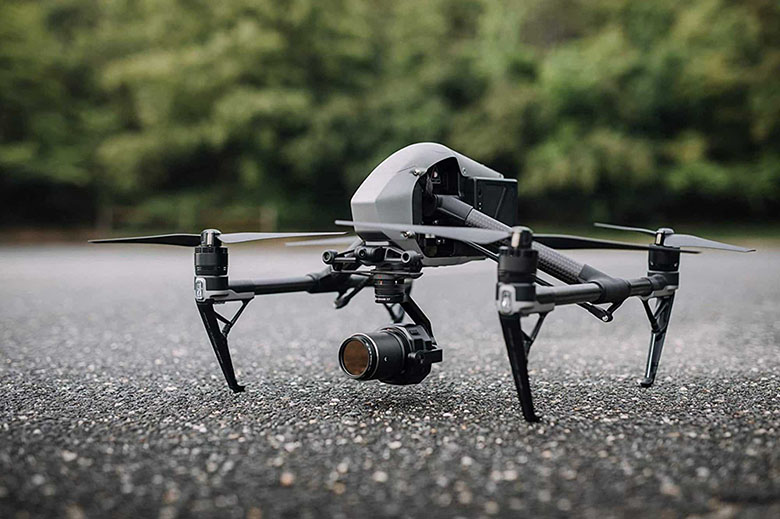
DJI’s professional-grade Inspire 1 drone has seen various modifications throughout the years. The camera’s modular architecture enabled this, with the base 1/2.3-inch X3 4K camera giving way to Micro Four Thirds X5 and X5 Raw variants. However, it is now time for a completely new airframe with two new camera choices, considerably better speed, and an obstacle avoidance system. The Inspire 2 ($6,198 as tested) is destined to be the favorite drone of professional filmmakers, local news stations, and wealthy hobbyists since it has capabilities that demanding aerial videographers need, such as dual-operator control and professional-grade video compression. It is our Editors’ Choice for premium drones.
2022 DJI Inspire 2 Drone – Features and Price
Design
The Inspire 2 is a large drone ($3,089.00 at Amazon)(Opens in a new window). It has four rotors and is more minor than the competitive pro-grade Yuneec Tornado H920. The proportions of the aircraft vary somewhat depending on the location of its landing gear. When ready to take off, the distance between each motor is about 1.2 feet. Switching to travel mode, which allows you to store the drone in the provided carrying case, expands its footprint while decreasing its height. It weighs roughly 7.3 pounds without a camera, so you’ll probably need to register with the FAA before taking off.
When the Inspire is on the ground, the landing gear restricts the camera’s left and correct views. Still, it lifts once the drone is airborne, enabling the camera to gaze left, right, backward, and in any direction with an unobstructed view. In contrast to the plastic shell that protected the internals of Inspire 1, its body is now made of magnesium alloy. The landing gear is still made up of carbon fiber.
There are two cameras to choose from. The Zenmuse X4S is a $599 add-on that is not included in the $2,999 base price or the $6,198 configuration discussed here. It uses the same 1-inch 20MP image sensor, 24-mm f/2.8-11 lens, and mechanical shutter as the Phantom 4 Pro ($3,089.00 at Amazon)(Opens in a new window). It has the same fixed field of view as a 24mm lens on a full-frame camera system.
Two remotes are supported, one for the pilot and one for the camera operator. In contrast to the Phantom 4 Pro, the Inspire 2’s remote controllers lack an embedded tablet. Because all of the footage from the front camera and the Zenmuse camera is relayed over the same stream, the two operators must be within 328 feet (100 meters) of each other while working together. If you wish to separate flight and camera control, you’ll need to purchase a second remote for $549.
Camera Options
For this review, we got the premium Zenmuse X5S. The compact Micro Four Thirds camera enables lens adjustments, CinemaDNG video recording at up to 5.2K resolution, and 20MP stills in DNG and JPG formats. It’s much smaller than the comparable CGO4 camera Yuneec includes with the H920 ($3,089.00 at Amazon)(Opens in a new window). In addition, unlike the H920, which has a recessed lens mount, third-party lenses may be used using a mechanical adapter as long as they are tiny and light enough not to put too much pressure on the stabilizing gimbal. The kit includes a 15mm f/1.7 lens that looks like a DJI-branded version of the Panasonic Lumix G Leica DG Summilux 15mm f/1.7.
In addition to the camera and lens, the package contains the software licenses required to record CinemaDNG and Apple ProRes video. There is a 16GB microSD card supplied but no SSD, which is necessary to utilize the professional formats. You may purchase one depending on your storage requirements—120GB for $299, 240GB for $499, or 480GB for $899—and you’ll want to obtain the CineSSD Station for $149 to transfer film to a computer.
2022 DJI Inspire 2 Drone – Performance
The Inspire 2 is a high-end aircraft that provides high-end performance. According to my flight records, its cruise speed is 40mph in regular mode, and I took it up to 69mph in Sport mode. To fly in Sports, you’ll need a large, unobstructed area since it disables the obstacle avoidance function and demands more space for stopping.
Battery life is adequate for its size and weight. I landed with a 20% charge left after two flights that averaged 20 minutes and traveled around 13,000 feet in distance. I landed with 37 percent power left after a trip with more consistent movement, covering about 19,000 feet in 14 minutes. Depending on your flying style, the X5S should provide you with 20 to 25 minutes of flight time. According to DJI, the X4S has extended flying times.
There are various incorporated safety measures, including the essential Return-to-Home function, which returns the Inspire to its launch location if contact between the remote and the aircraft is broken. RtH may also be activated manually, and obstacle avoidance is enabled, reducing the possibility of an accident.
As long as the I2 is flying ahead, obstacle avoidance sensors in the nose keep it from colliding with obstacles. The technology can identify things up to 100 feet away. Because the camera may rotate to face any direction, if you’re in a scenario where a collision is conceivable, you should strive to fly ahead as much as possible. There are also upward-facing IR sensors, albeit their detection range is significantly more restricted at 16 feet. When operating inside without GPS stabilization, sensors on the bottom detect topography and height changes along with hills when flying low and recognize patterns underneath the drone for steady flight. Because the I2 is a large bird, we could not try indoor flying.
Video and Image Quality
Even while recording in the poor H.264 codec, the aerial video produced by the Zenmuse X5S is fantastic. The large Micro Four Thirds sensor, paired with the flexibility to change lenses, significantly expands the capabilities of a drone. The provided lens has a narrower field of vision than most airplanes, but only marginally—around 30mm in full-frame equivalent terms.
In addition to the 15mm f/1.7, I traveled with a few more lenses. A 25mm f/1.8 Olympus lens is compact enough to operate with the X5S gimbal and has a typical standard-angle field of vision. The air will not provide panoramic vistas, but it will increase your sensation of depth and motion. I also utilized the Olympus 12mm f/2, a compact wide-angle lens with a manual focus ring. I set it to infinity so I wouldn’t have to worry about autofocusing during flight—if you want AF, you’ll have to touch the screen to select a focal point.
Conclusions
Combined with the X5S camera and gimbal, the DJI Inspire 2 produces the most incredible footage of any drone. Its cost is exorbitant for most people, but it is an excellent investment for video production firms and news organizations and a pittance for Hollywood studios. The flexibility to utilize multiple lenses greatly expands creative choices and produces a film that does not look like every other drone on the market. The huge Micro Four Thirds sensor has a video with depth that tiny sensor drones do not.
The airplane itself is a work of art. It is built to a professional standard, with redundant flying systems, obstacle avoidance, and the capability for dual-operator control. It soars through the air rapidly in Sport mode and glides smoothly in a Standard manner.
If you’re a pro working on projects that need CinemaDNG or ProRes video capture, the Inspire 2 is the obvious choice and our Editors’ Choice in the pro drone space—it’ll pay for itself in no time.

 The Post